
Light Sequence: Spatial Memory and the Corsi Blocks
A memory test that uses places instead of words. Where it comes from and what a typical span looks like.

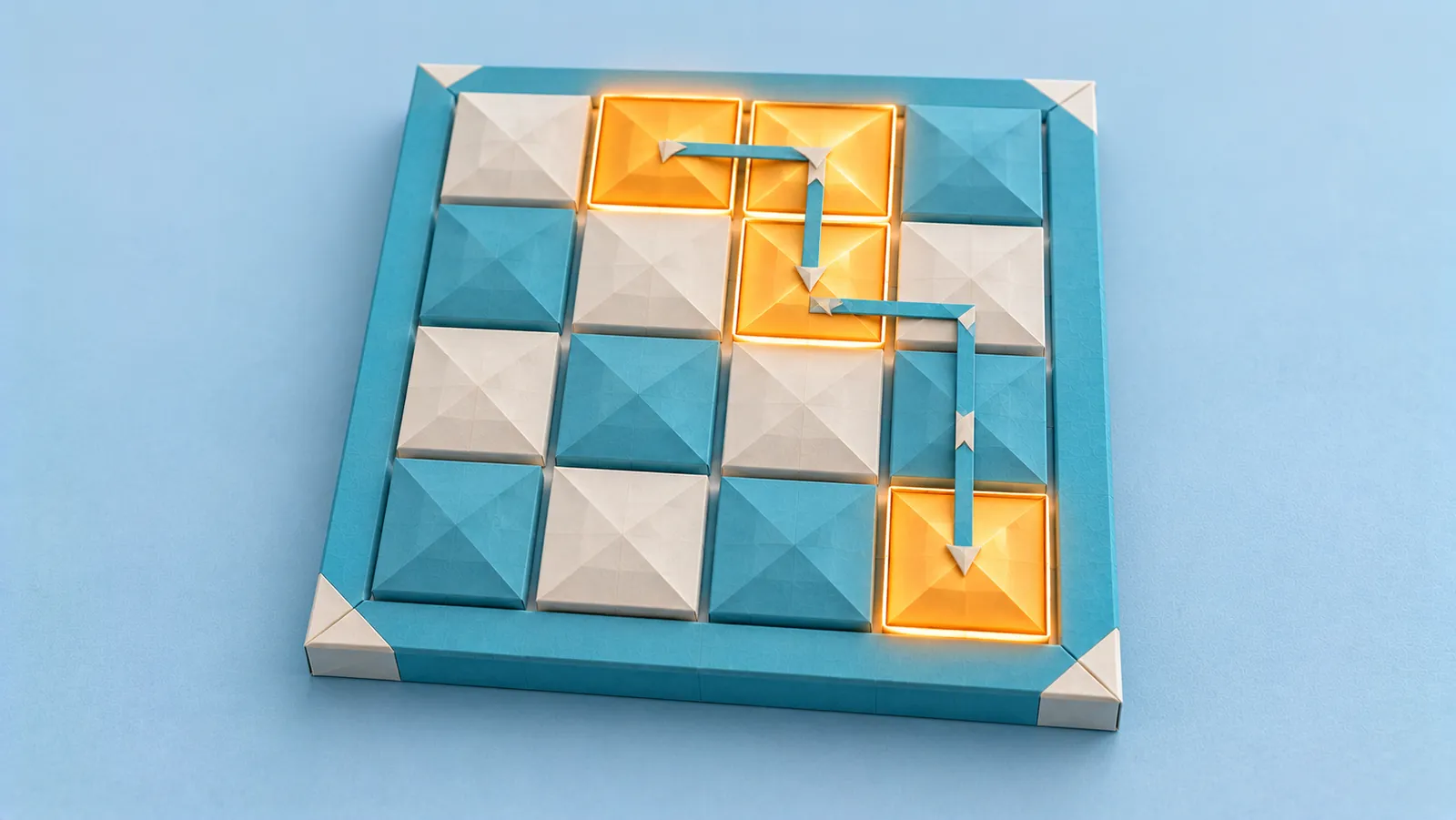
Most memory tests use words or numbers. Light Sequence uses places. Squares light up one after another, and you repeat the order. It is a version of one of the best-known spatial memory tests in psychology.
How to play
Watch the squares light up, then tap them in the same order. Each step adds one more square. Level 1 uses a 3 × 3 grid with 10 steps; level 2 uses a 4 × 4 grid with 12 steps and unlocks once you finish level 1. A mistake restarts the level.
Where it comes from
In 1972, Philip Corsi created the block-tapping test: an examiner taps a sequence on a board of wooden blocks, and the person taps it back. The longest sequence you can repeat is your spatial span. Later studies collected norms; for most adults the forward span is around five to six blocks.
What the task uses
Visuospatial working memory: holding locations and their order in mind for a few seconds. It is a separate system from remembering words, which is why some people are much better at one than the other.
What practice can change
Scores improve with practice, often because people find strategies, like tracing the path as a shape. That is real improvement at this task. Research on memory training in general finds little evidence that it improves other kinds of thinking.
A worked example
Say the sequence is top-left, centre, bottom-right, top-right. That is four places, but you can remember it as one shape: a diagonal line going down, then a jump back up to the right. Turning the order into a shape or a path is one of the most effective strategies people use in this kind of test.
Common mistakes
Trying to remember each square as a separate item gets hard quickly. Tapping too fast before the order is clear in your mind is another mistake. And looking away during the sequence, even for a moment, usually means missing a step.
Questions people ask
What is a normal span? In research versions, many adults repeat about five to six locations forward.
Is reverse order harder? Yes. Repeating backwards needs you to hold and rearrange the order, so it is a tougher test of working memory.
Does practice help? You will improve, often by finding better strategies.
Tips
Picture the sequence as a path or shape rather than single squares. Not medical advice.
Sources
Not medical advice. Stop if you feel dizzy, nauseous or strained.