
Eye Warm-up: What a Two-Minute Eye Routine Can and Cannot Do
A short glide-and-jump routine for your eyes before training. Here is what it actually does, and the claims it does not make.

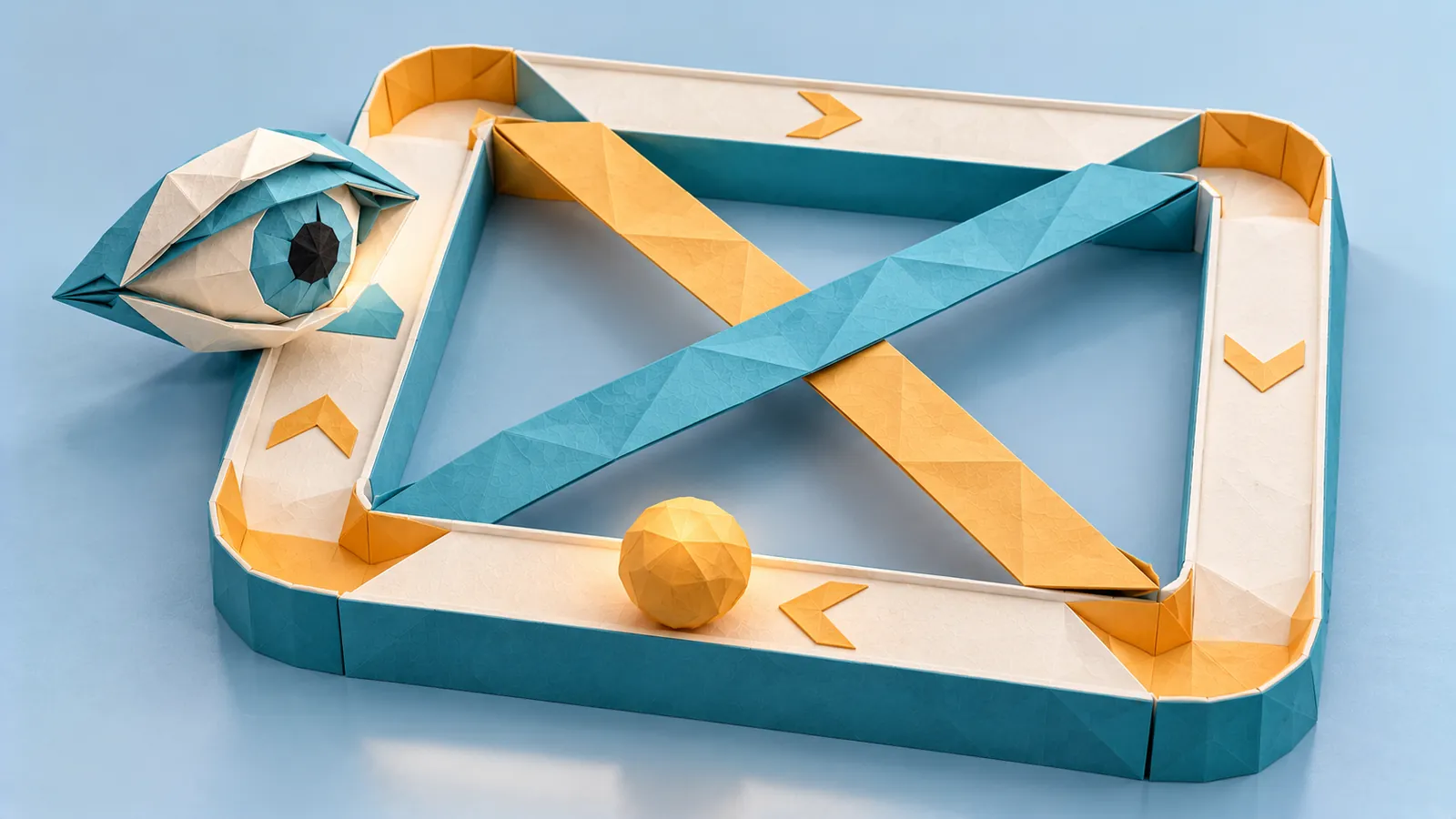
Before a game or a training session, a lot of people like to "wake up" their eyes. Our Eye Warm-up is a short routine for exactly that: a ball glides left and right, up and down, jumps between the edges, runs along the diagonals, then around a box and a circle, forwards and backwards.
It has no score, on purpose. Here is why, and what the routine really does.
How to play
Sit at a comfortable distance and keep your head still. Follow the ball with your eyes, not your head. Pick a speed from 0.5× to 3×. Start slow; you can always go faster next time.
Two kinds of eye movement
The routine mixes the two main ways your eyes move. When the ball glides, your eyes use smooth pursuit: a slow, continuous movement that keeps a moving target sharp. When the ball jumps from edge to edge, your eyes make saccades: very fast jumps from one point to another. You make several saccades every second while reading this sentence.
Both are controlled by circuits in the brainstem and the brain's eye fields. Their top speed is fixed by that wiring. Practice does not raise it.
Why there is no score
We do not use a webcam or an eye tracker, so we cannot see your eyes. Any score would be a guess. Instead, the warm-up is a guided routine that helps you settle, focus on the screen and get ready for the tasks that do have scores.
What it does not do
Eye exercises do not sharpen your vision or reduce a glasses prescription. We wrote a full article on that, with the evidence. A warm-up also has not been shown to improve performance in games or sport by itself. It is a calm way to start, not a performance boost.
A worked example
Say you have five minutes before a gaming session. Sit at your normal distance, rest your chin lightly on your hand if that helps you keep your head still, and pick 1×. Follow the ball through the left-right glides, the up-down glides and the edge jumps. When it runs along the diagonals and around the box and circle, notice whether your eyes keep up smoothly or start to jump behind it. That jumping is normal at higher speeds: your eyes are using quick catch-up movements. Next time, try 1.5× and see how it feels.
Common mistakes
Moving your head instead of your eyes is the most common one. It makes the routine easier but turns it into a different task. Another is starting at the top speed. Fast speeds feel impressive but can cause eye strain or mild motion sickness. Finally, some people stare so hard that they stop blinking. Blink normally throughout.
Questions people ask
Will this improve my eyesight? No. Eye movement routines do not change the sharpness of your vision or your prescription.
Why is there no score? Without an eye tracker we cannot measure where your eyes are, so any score would be made up.
How often should I do it? Once before a session is plenty. It is a warm-up, not a workout.
Tips
Blink normally. If the fast speeds feel uncomfortable, stay at 1× or below. Two to three minutes is plenty. Not medical advice: stop if you feel dizzy, nauseous or strained.
Sources
- Lisberger (2010): Visual guidance of smooth-pursuit eye movements, Neuron
- American Academy of Ophthalmology: Can eye exercises improve my eyesight?
Not medical advice. Stop if you feel dizzy, nauseous or strained.